welcomeDawopu Group
Language selection:
 ∷
∷

∷
 ∷
∷
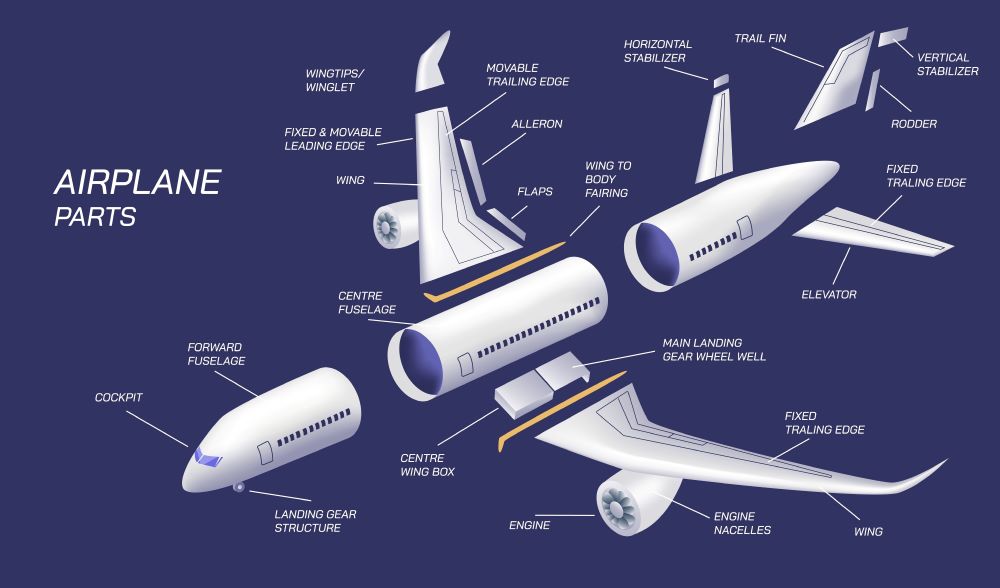
Learn the basic structure of an airplane while in flight school at Leopard Aviation. Contact our flight instructors today for more information about enrolling.
One of the first things an aspiring pilot learns in flight school is the various sections of an aircraft. From the navigation display to the wing structure, understanding all segments of an airplane is crucial in the aviation industry. If you’re wondering how to become a commercial pilot in Arizona, this in-depth guide to important aircraft parts will help in your pursuit.
The body of an airplane is known as the fuselage. This long, metal tube connects all the main components of an airplane. Its design plays an integral part in keeping the flight crew, cargo, and passengers safe because it can withstand changes in atmospheric pressure.
One of the best-known parts of an aircraft is at the front and center of the fuselage. Pilots navigate the airplane forward in glass cockpits, which are located just over the aircraft’s nose. The cockpit, also called the flight deck, is where pilots use electronic flight instruments as part of a primary flight display.
Most aircraft have an advanced flight management system that oversees critical systems in a multi-function display, including:
Fuel usage
Hydraulic control
Electric motors
The pilot will maintain these key parts of an airplane through various controls and large LCD screens inside the cockpit. They will also communicate with air traffic control about any flight safety alerts should an issue arise with the electronic flight instrument displays.
One of the most valuable airplane parts that connect to the fuselage is the wings. The wings work with other sections of an aircraft to increase lift and adjust stalling speed. Fixed-wing aircraft generate lifting force thanks to the wings, which stem from the top, middle, or lower part of the fuselage.
The wing root is the piece that appears closest to the fuselage, while wing ribs support the aircraft’s structure. Below are other critical pieces of the wings that help give the plane additional lift, reduce drag, or achieve lower speeds in preparation for landing:
Ailerons: A French word meaning “fin” or “little wing,” the aileron helps control the airplane’s roll. For example, if the right aileron rises and the left aileron goes down, the aircraft will change directions.
Trim tab: The aileron and trim tab work together to counteract any aerodynamic force the plane encounters.
Wing flaps: Located on the trailing edges of the wings, the flaps are movable surfaces that help overcome drag.
All of these primary control surfaces serve as a horizontal stabilizer for the plane. You’ll find them on either the leading edge or trailing edge of the wing.
The primary function of the empennage or tail assembly of an airplane is to keep the aircraft stable despite the rotational energy of relative wind. Of all the sections of an aircraft, the tail assembly is perhaps the most important for keeping an airplane in the air safely.
What are the basic parts of this section? You’ll find a horizontal stabilizer, vertical stabilizer, elevator, and rudder pedals here. Along with these elements of aircraft structure, the empennage contains the tail number, which is the unique identifier for each individual aircraft.
Static wicks appear on the trailing edge of the plane to capture and dissolve static electricity that some parts of an airplane absorb.
All other airplane sections depend on the aircraft engine. After all, this is what powers the plane for the duration of a trip. It’s another one of the most important parts of an airplane.
Various aircraft engines are in use throughout the aviation industry, including:
Piston engines: Smaller planes use this system for primary flight control. The engine creates thrust by burning fuel.
Jet engines: These engines create an electric spark by compressing air and igniting it with fuel.
Turboprop engines: This system combines piston and jet engines and uses gas turbines to power the propeller, which consists of two or more blades and appears in the front of the plane.
Closing out our list of notable sections of an aircraft is the landing gear. The wheels, struts, and other parts of an airplane crucial for ground operations are known as the landing gear. The wheels often contain shock absorbers to minimize the impact of landing your plane.
Small planes tend to have fixed landing gear, while commercial airliners have retractable gear.
Contact:Mr Liu
Mobile:15869109368
Tel:86-571-89967020
E-mail:info@dawopu.com
Address:No151 ,ZiDingXiang Rd, Hangzhou. Zhejiang Province, China