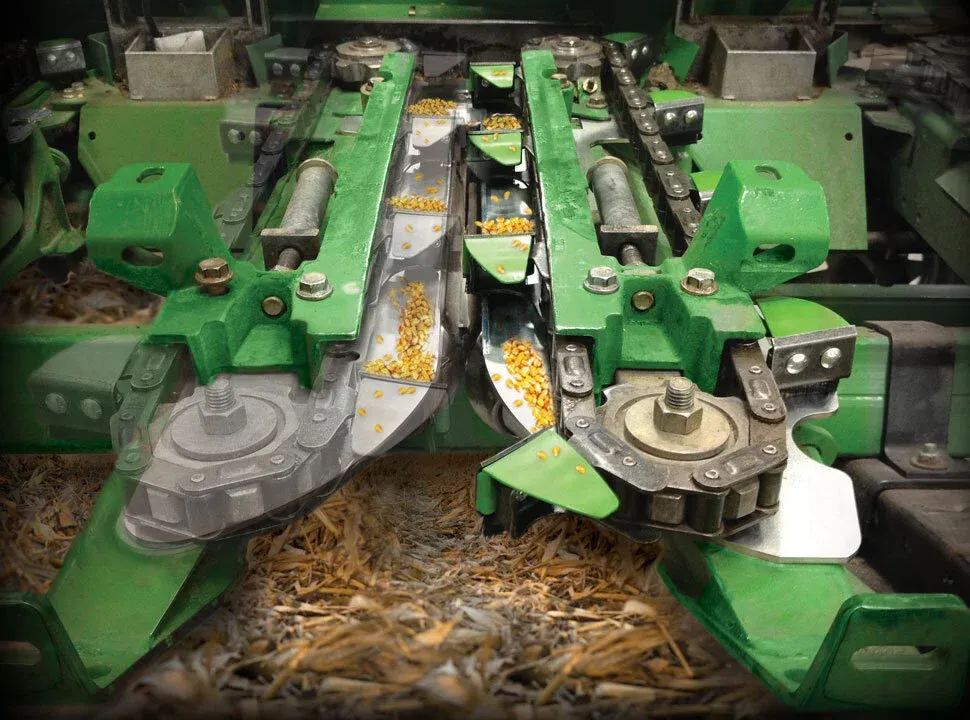
Most corn farmers are familiar with common harvest yield loss issues, such as corn ears falling off headers or grain kernels bouncing onto vehicle windshields during harvesting. However, many operators of mainstream corn headers overlook a subtle yet critical problem: deck plate wear, a hidden issue that steadily cuts crop yields and compromises harvest efficiency. As a professional agricultural machinery equipment supplier, Dawopu deeply analyzes the root causes of deck plate wear and delivers optimized corn header solutions to effectively avoid unnecessary yield loss.
Deck plate wear primarily stems from concentrated stalk processing. During operation, cornstalks are entirely processed within the first few inches of the knife rollers, resulting in repeated friction at fixed positions on the deck plates and forming uneven wear marks. With prolonged use, obvious indentations will appear on the plate surface, and severe wear can even cause plate penetration. This faulty processing mode is triggered by high-speed, short knife rollers with intermeshing blades. These structural flaws prevent cornstalks from moving smoothly along the full length of the row unit during threshing, concentrating all processing pressure on the front section of the rollers.

Uneven deck plate wear is a direct warning sign of inefficient stalk processing and potential yield reduction. In most cases, one-sided deck plate wear occurs because hydraulic plates push cornstalks away from the row center, leading to asymmetric friction and excessive abrasion on a single side of the header unit. The more severe the deck plate wear, the wider the gap between paired plates. This enlarged gap easily causes grain shattering, ear bounce, and stalk slippage, further exacerbating yield loss.
Beyond yield reduction, improper stalk processing caused by worn deck plates also brings additional operational troubles. Rapid, forced front-end stalk processing increases the volume of impurities and crop debris entering the combine. Excessive trash accumulation burdens the combine’s internal processing system, reduces grain cleaning and threshing efficiency, and raises equipment wear and failure risks.

To solve deck plate wear and related yield loss problems fundamentally, Dawopu equips high-performance Drago corn headers with upgraded structural designs, focusing on balanced wear resistance and stable stalk processing. Different from ordinary corn headers, Dawopu’s supporting deck plates feature thickened rolled edges, which achieve uniform stress dispersion and more even overall wear, avoiding local indentation and penetration damage.
Meanwhile, the automatic self-adjusting deck plate system configured on Dawopu Drago corn headers can precisely center cornstalks in the row unit. This centralized positioning eliminates one-sided friction, ensures consistent wear across the entire deck plate surface, and greatly extends the service life of core components.
Dawopu prioritizes optimizing stalk processing strokes to reduce yield loss. The Drago corn headers adopt the industry’s longest knife rollers, a core design that extends stalk processing time thoroughly. The opposed blade structure features a unique grab-and-release working mode, which guides cornstalks to move steadily along the full length of the row unit instead of being squeezed and pulled only at the front end.

These premium Dawopu knife rollers adopt a small-diameter design, enabling low-RPM stable operation. This gentle processing mode effectively reduces butt shelling and corn ear bounce without lowering field operating speed, balancing harvest efficiency and yield protection. Additionally, the full-length stalk processing fully crushes and separates crop stalks, cutting down impurity intake and improving the combine’s continuous operating stability.
Furthermore, Dawopu optimizes the offset layout of Drago knife roller blades. The offset blade structure realizes periodic grabbing and releasing of cornstalks, ensuring each stalk is processed evenly along the entire row unit. The professional knife-to-knife extrusion and traction structure gently pinches, pulls, and separates stalks, allowing corn ears to detach completely and stably only after moving deeper into the corn header. This refined processing mechanism eliminates the hidden yield loss caused by incomplete threshing and grain shattering, bringing stable and high-yield harvest results for farmers.