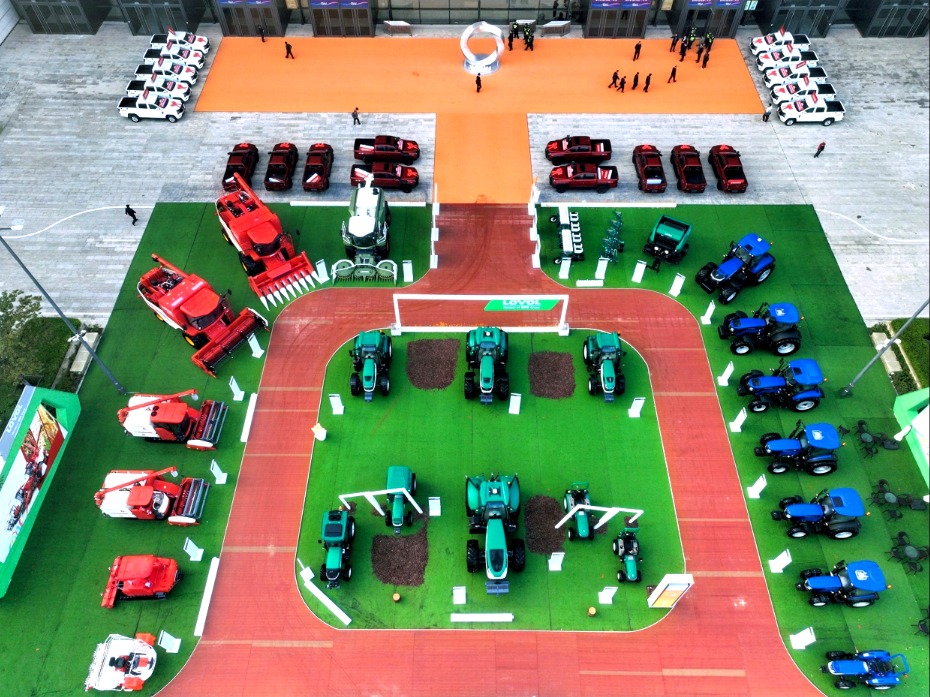
Breaking New Ground in Overseas Expansion: Who Will Lead China’s Agricultural Machinery to High‑End Success?
As the world’s largest agricultural machinery manufacturer, China has seen steady year‑on‑year growth in agricultural machinery exports, with its global footprint continuously expanding. Behind this impressive volume growth, however, structural shortcomings in export mix and insufficient high‑end competitiveness constrain China’s agricultural machinery industry from merely “going global” to truly “moving upmarket”. Riding the tides of the era, China’s agricultural machinery sector calls for leading enterprises with full‑chain R&D capabilities and global deployment expertise to spearhead its breakthrough.
In recent years, Weichai Lovol Intelligent Agriculture, backed by a fully self‑owned industrial chain, sustained heavy investment in innovation and coordinated domestic‑overseas production capacity, has emerged as a core driver propelling China’s agricultural machinery industry toward the global high‑end market. Through multi‑dimensional coordination of policies, technologies, business models and industrial resources, it is well‑positioned to help Chinese agricultural machinery escape red‑ocean low‑end competition and build robust global competitiveness.
Steady Export Growth Held Back by Structural Bottlenecks for Global Upgrading
China’s total exports of agricultural machinery have risen steadily in recent years, pointing to a generally positive outlook for industry internationalization. Data from the General Administration of Customs for Q1 2026 shows China’s exports of agricultural machinery and spare parts reached USD 5.94 billion, a year‑on‑year increase of 28.9%. Exports to Belt and Road partner countries grew by over 30%. Driven by sustained overseas market demand, the fundamental base of agricultural machinery exports keeps expanding. Products are supplied to more than 120 countries and regions across Southeast Asia, Central Asia, Africa, South America and Europe, with overseas revenue climbing year after year.
Nevertheless, prominent structural flaws persist beneath strong export volumes, capping the industry’s global development potential.
First, exported products remain at a relatively low tier. Small‑and‑medium‑power walking tractors, simple harvesters and basic accessories constitute major export items. High‑end intelligent tractors above 300 horsepower, large‑feed‑rate harvesting equipment and smart solutions for unmanned farms account for less than 10 % of total exports, leaving a severe supply gap in high‑end segments.
Second, the industry is “large but not strong”. China ranks first globally in agricultural machinery manufacturing output yet boasts extremely low market penetration in mainstream high‑end farm markets in Europe and North America. It wields limited influence over international standard‑setting and brand pricing.
Third, overseas business models are limited. Most small‑and‑medium‑sized enterprises only engage in complete‑machine hardware sales. They lack supporting services including local‑based operation & maintenance, technical training and financial services. Inadequate after‑sales support prevents them from building solid and long‑term overseas market foundations.
Industry experts acknowledge that current overall technical performance of China’s large high‑end agricultural machinery reaches merely 60‑70 % of world‑leading benchmarks, with over 80 % of core components relying on foreign supplies. Traditional strategies of fragmented overseas sales and price‑driven competition cannot drive industrial upgrading, nor reverse the global perception of Chinese agricultural machinery as low‑end. Breaking through high‑end bottlenecks has become imperative.
Three‑Dimensional Advancement Toward High‑End Segments to Resolve Systemic Industrial Bottlenecks
To escape low‑end red‑ocean competition and target high‑end tracks, concurrent progress must be made across markets, technology and business models. The roadmap for China’s agricultural machinery in fiercely contested international markets is clear‑cut.
Market breakthrough: From market access to mainstream acceptance. Moving away from low‑price competition, Chinese manufacturers shall proactively target global large‑scale high‑end farm markets. Tailor‑develop high‑horsepower, highly‑reliable and complete sets of intelligent agricultural equipment for contiguous large‑farm operations in Europe‑America, Central Asia, Australia and other regions. Fill gaps in domestic high‑end product supply abroad, reduce over‑reliance on low‑end markets in developing economies, and establish a multi‑tiered, comprehensive global market matrix.
Technological advancement: From follower to parallel competitor. Concentrate resources to address full‑chain core weaknesses. Prioritize breakthroughs in four key areas: high‑end complete‑machine design, specialized supporting implements, high‑end transmission and hydraulic components, and vehicle‑mounted intelligent control systems. Improve long‑term reliability and durability of finished products, narrow performance gaps with global giants, achieve independent control of core technologies, and reduce reliance on imported high‑end machinery at source.
Model innovation: From product sales to ecosystem building. Move beyond conventional pure‑product export toward an integrated overseas model covering complete‑set equipment supply, digital farming solutions, local manufacturing & operation and on‑site service & training. Alongside physical hardware, deliver smart‑agriculture cloud platforms, machinery dispatching systems and field crop‑management solutions. Set up parts hubs, service stations and technical‑training bases in key overseas markets to form a full‑lifecycle overseas service system and comprehensively lift overall brand competitiveness.
Leading Enterprises Drive Collective Breakthrough and Shoulder Overseas Expansion Responsibilities
“A single tree cannot form a forest; many hands make light work.” For Chinese agricultural‑machinery firms, global expansion is no solo performance, but a team‑based campaign calling for coordinated efforts across the whole industrial chain. In this systematic overseas push, leading enterprises play an indispensable role: they act as assault troops for technological innovation, coordination hubs for resource integration, and standard‑bearers for brand building.
As the chain‑leader enterprise of China’s national agricultural‑equipment industrial chain, Weichai Lovol Intelligent Agriculture stands among China’s most capable and promising agricultural‑machinery champions, well‑equipped to steer industry‑wide advancement. It operates China’s only full industrial‑chain ecosystem covering complete machinery, core transmission components and smart‑agriculture software. Its annual R&D investment ranks among the industry’s highest. Products are sold in over 120 countries and regions worldwide, making it one of few domestic manufacturers capable of competing in global high‑end markets. In the first half of this year, Weichai Lovol Intelligent Agriculture reported a 54 % year‑on‑year rise in overseas export revenue, hitting a new record.
Benchmark‑setting effects from leading enterprises generate strong industrial spillover. Should Weichai Lovol Intelligent Agriculture surmount technical barriers in high‑end overseas markets and establish global brand and distribution channels, it can open up component‑supply and overseas‑distribution resources for hundreds of upstream and downstream suppliers. Supporting enterprises will thus align with international standards and upgrade manufacturing processes, creating a virtuous cycle where individual breakthroughs trigger industry‑wide improvement.
Multi‑party Coordination to Fuel Comprehensive Industrial Upgrading
Global success for China’s agricultural machinery calls for joint efforts from enterprises, policies, technologies and industrial stakeholders to back leadership‑driven transformation.
First, deliver targeted policy support. Roll out special incentive schemes for leading enterprises, boost funding for high‑end agricultural‑machinery core‑technology R&D, and offer financial backing for building overseas channels and local‑service networks to cut global‑layout costs.
Second, refine the indigenous innovation system. Bring together research institutes and industrial players to form industrial innovation consortia. Tackle key technologies such as core components and intelligent control systems, build national‑level innovation platforms, accelerate technology transfer, and foster a self‑reliant high‑end agricultural‑machinery industrial chain.
Third, upgrade global deployment. Support leading enterprises in building integrated marketing‑and‑service networks in priority markets. Deepen regional market presence via investment, mergers & acquisitions and local production, pool overseas technical and channel resources, participate in international standard‑setting, and build home‑grown brands with global influence.
Fourth, deepen full‑chain collaboration. Leverage leading enterprises to push supporting suppliers toward technical upgrading, build collaborative innovation platforms, assist small‑and‑medium‑sized firms in meeting international standards and raising product quality, and lift overall industrial competitiveness.
Growing from scale to strength, from “going global” to “moving upmarket”, China’s agricultural‑machinery sector needs not only volume expansion but also all‑round advancement in technology, business models and institutional systems. In this global competitive contest, domestic champions represented by Weichai Lovol Intelligent Agriculture are stepping forward to achieve breakthroughs. They have become vital forces steering China’s agricultural machinery toward new global horizons and shouldering the historic mission of industrial transformation.